
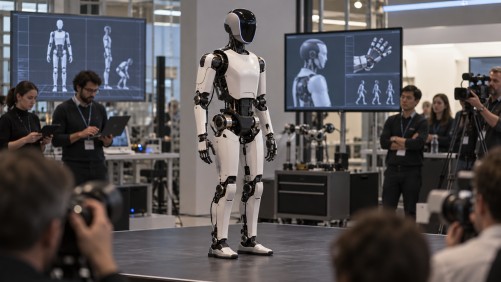
OpenAI is making strides towards the physical embodiment of artificial intelligence by planning to demonstrate a humanoid robot in 2027. This initiative, led by CEO Sam Altman, marks the company’s attempt to extend AI capabilities from digital to physical applications.
Developing a humanoid robot presents significant challenges for OpenAI, particularly in creating AI systems that can accurately perceive their environment, interpret instructions, and reliably control mechanical functions. A humanlike design is considered advantageous since it aligns with environments and tools primarily designed for human use, potentially easing the integration of robots into everyday settings.
The company has not disclosed specific details regarding the robot’s design or its technical specifications. However, the project will require advancements in several areas, including perception, movement, decision-making, and the coordination of mechanical components to ensure safety and efficiency in task execution.
OpenAI is actively recruiting experts in robotics software and hardware, focusing on control systems, motion technologies, motor design, machine learning, and manufacturing, indicating a comprehensive approach to developing the necessary infrastructure for practical robotic applications.
In pursuing this ambitious project, OpenAI faces competition from other major players. Tesla is working on its Optimus humanoid robot, and Chinese automaker XPENG has already showcased its IRON robot, highlighting the growing trend of integrating AI with machines to perform physical tasks.
Beyond the humanoid form, OpenAI envisions developing general-purpose robots that could assist skilled workers in infrastructure projects and eventually support various everyday activities. This broader ambition underscores the company’s commitment to exploring diverse robotic designs and applications.